

Modern Gunships: AC130 WarGame
ForgeGames Mobile
Modern Gunships: AC130 WarGame puts me in the seat of a heavily armed AC130 and asks me to turn aerial firepower into battlefield control. That premise is immediately clear, but the game is more interesting when I stop treating it as a simple shooting app and start looking at the decisions behind each attack: where to aim, when to hold fire, how much pressure I want to accept, and whether spending money would genuinely improve the experience for me.
This is a free action game from ForgeGames Mobile, rated 4.7 on average from around 16 thousand ratings, with more than 500 thousand installs. It is aimed at Teen players and runs on Android 7.0 or later. The current release is version 1.0.3, and the game arrived on April 7, 2025. Those details matter because this feels like a relatively new title that is still establishing its identity, rather than a mature military game with years of accumulated systems and content.
I spent time judging it less by the excitement of its store pitch and more by the practical question most players eventually ask: is this a satisfying free game when I do not want to spend anything, or does the design keep nudging me toward purchases? My answer is cautiously positive. The core fantasy is easy to enjoy, but players who dislike repetition, monetization pressure, or uncertainty around long-term progression should approach it with some restraint.
What it feels like to command the gunship
The strongest part of the experience is the unusual viewpoint. Instead of running through a level as a soldier or driving a conventional vehicle, I am managing a flying weapons platform from above. That changes the rhythm of an action game. I am not simply reacting to enemies in front of me; I am scanning the battlefield, choosing a firing angle, and trying to make each attack count.
That perspective gives the game a slower, more deliberate tension than a typical mobile shooter. The satisfaction comes from lining up a useful attack rather than constantly moving a character through cover. When the battlefield is busy, the screen can feel like a problem to solve: which threat deserves attention first, which target can wait, and whether a burst of fire is worth using immediately or saving for a more dangerous moment.
Related News

Threads in Real Life: Who Should Join, Lurk, or Leave

How SHEIN Turned Shopping Into an Endless Content Feed

How to Make Fortnite Feel Smarter on Mobile

Should You Switch to Microsoft Outlook on Mobile?

Why Gallery Keeps Pulling Users Back

X Review: Why Its Network Still Matters
I also like that the AC130 concept gives the game a clear personality. Many mobile action games blur together because they use familiar soldier, zombie, or arena formats. Here, the gunship is the reason to keep playing. If you enjoy military equipment, aerial combat viewpoints, and the feeling of controlling a platform more powerful than a single infantry unit, the premise does real work instead of being a thin visual theme.
At the same time, the concept creates a limitation. Players who want fast movement, close-range duels, or direct character control may find the experience less energetic than expected. The aircraft perspective is the attraction, but it also narrows the type of action available. I would not recommend it to someone looking for a full first-person shooter replacement. It is better understood as a focused gunship action game than as a complete modern combat simulator.
Learning to spend attention, not just ammunition
My most useful adjustment was to stop firing at the first visible target. The game becomes more satisfying when I treat the battlefield as a priority list. I look for the threat that can cause the most trouble, then consider whether eliminating it now creates a safer window for everything else. That habit is more valuable than simply tapping quickly, because the gunship fantasy depends on control and timing.
Gallery
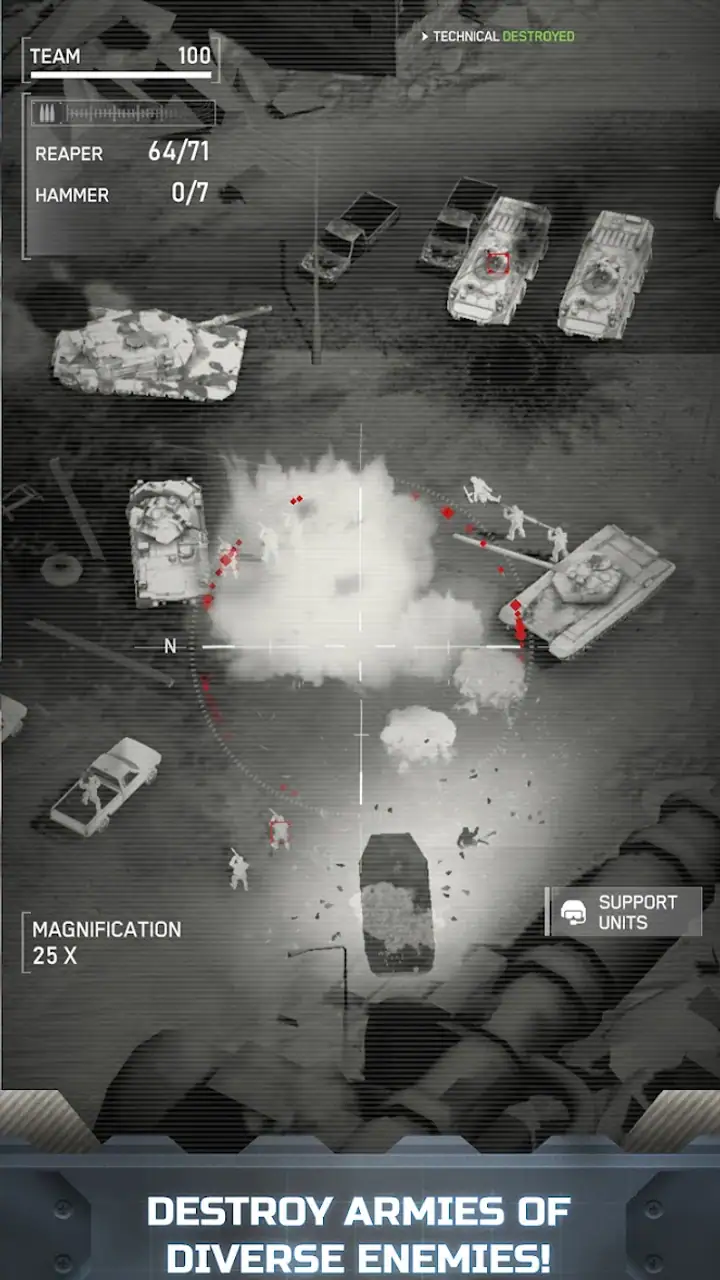
A practical routine is to begin each encounter by observing for a moment. I check where the pressure is coming from, identify the target that could interrupt my plan, and only then commit to an attack. This is especially helpful for players using a phone rather than a large tablet, where hurried taps can make the action feel messy. A short pause before firing often produces a cleaner result than frantic input.
Another useful trade-off is deciding whether to chase immediate destruction or preserve flexibility. A powerful attack can feel rewarding, but using everything at once may leave me with fewer answers when the battlefield changes. Even without turning the game into a spreadsheet, I found that restraint improved my consistency. The best runs were not always the most explosive ones; they were the runs where I avoided wasting attention on targets that were already under control.
This is also where the game’s accessibility becomes apparent. You do not need to understand military terminology to start playing. The basic fantasy is readable within minutes, and the action is more approachable than a complex strategy game. However, players who want deep simulation, realistic aircraft handling, or detailed squad management should lower their expectations. The appeal is the feeling of commanding an AC130, not reproducing every technical aspect of operating one.
Progression pressure and the cost of impatience
The game is free to download, but it includes in-app purchases ranging from $0.99 to $199.99 per item. That is the most important spending context for a new player. The wide gap between the lowest and highest listed purchase points means I would not enter the game casually assuming that every optional payment will feel minor. Anyone who is sensitive to large purchase options should decide on a personal limit before playing.
I prefer to begin a free action game by seeing how far the basic loop carries me without paying. With this title, that approach is particularly sensible because the main question is not whether the gunship is fun at first; it is whether the progression remains enjoyable after the novelty fades. If I feel that I am playing only to reach the next upgrade or to escape an artificial slowdown, that is a sign to stop rather than automatically spend.
The pressure of progression can affect different players in different ways. A relaxed player who enjoys short sessions may be perfectly happy repeating familiar combat and improving gradually. Someone who wants to unlock everything quickly may feel more tempted by purchases, especially if advancement becomes the main source of motivation. I would advise the second type of player to be extra careful, because urgency is often a poor reason to buy anything in a free game.
My practical rule is simple: never purchase during a frustrating moment. Finish the session, decide whether the core combat is still enjoyable without the upgrade, and only then consider whether the item solves a genuine problem. If the answer is merely “I want to skip waiting,” I would keep playing or leave the game instead. This approach does not remove every monetization concern, but it keeps the decision under the player’s control.
The purchase range also makes this game less suitable for children without supervision, even though the content rating is Teen. The rating describes the intended age category, but it does not replace a family spending rule. If a younger player uses the device, I would set clear limits before handing over the game, particularly because the title is free to start and therefore easy to install without thinking through later purchases.
Is the action fair when spending enters the picture?
Fairness is difficult to judge from the gunship fantasy alone. A powerful aircraft naturally suggests upgrades, stronger weapons, and improved performance, but those elements can either support a satisfying progression system or make non-paying play feel like a permanent disadvantage. I do not want to pretend that the purchase menu proves one outcome or the other. What I can say is that the presence of items priced as high as $199.99 means fairness deserves attention from anyone considering serious spending.
For my own play style, the safest way to evaluate fairness is to compare the experience before and after any optional purchase, rather than assuming that a higher price equals better value. I ask whether the item changes how I make decisions or simply removes the need to make them. A purchase that adds variety could be more meaningful than one that only makes every encounter easier, but players should make that judgment from their own experience instead of buying based on a dramatic description.
I would also separate competitive fairness from personal convenience. If the game is being played mainly as a solo action experience, a purchase may feel like a shortcut that affects only my own pace. If other players are involved in a shared contest, the question becomes more serious: paid advantages can change whether success feels earned. Because I do not want to invent systems the game may not use, I would not label it pay-to-win as a blanket verdict. I would simply avoid spending until I understand exactly what the item changes in the mode I care about.
That caution is not a criticism of every purchase. Some players value their time more than a completely free progression path, and paying for convenience can be reasonable when the cost is understood and controlled. My concern is the combination of a free entry point, a broad purchase range, and the natural temptation to improve a military platform quickly. The game is most trustworthy for me when I treat purchases as optional extras, not as the expected route to make the core action tolerable.
Compared with a traditional premium action game, this model asks for more personal discipline. A paid game usually makes its cost clear before play begins, while a free title lets the player form an attachment first and decide about spending later. Compared with another free mobile shooter, Modern Gunships: AC130 WarGame has a more specialized hook, but it also asks me to pay closer attention to how progression and purchases influence my enjoyment.
Who should play it, and who should skip it?
I think the game is a good fit for someone who wants short bursts of military action without committing to a large tactical campaign. It suits players who enjoy observing a battlefield from above, choosing targets, and feeling powerful without needing a complicated control scheme. It is also a reasonable choice for anyone curious about an AC130-focused game and willing to judge the experience gradually rather than expecting a complete simulation.
A realistic everyday use case would be a short evening session after work or school. I could play for a few minutes, focus on improving my targeting decisions, and stop before the game turns into a long commitment. The gunship format works well for that kind of concentrated play because I can get a sense of progress from making better choices, not only from spending more time in a huge story.
I would skip it if my priority is a deep narrative, realistic flight physics, open-world exploration, or highly personal character movement. I would also skip it if I know that large in-app purchase options make free-to-play games stressful. The game’s central idea is specific enough that it will not compensate for disliking the format itself. No amount of visual chaos can make an overhead gunship game feel like a close-quarters shooter for someone who wants that kind of control.
It is also not the right choice for a player who needs a clearly defined long-term competitive environment before investing time. The game was released on April 7, 2025, and its current version is 1.0.3, so I see it as an early-stage experience rather than a fully established platform with a long public history. That does not make it bad, but it does make patience more important. I would enjoy what is available now without assuming that the game’s future is guaranteed.
Small habits that make the game more enjoyable
My first tip is to separate aiming practice from progression anxiety. During a session, I focus on one improvement, such as choosing targets more carefully or avoiding unnecessary attacks. This gives the game a useful purpose even when I am not unlocking something immediately. It also helps reveal whether I genuinely enjoy the combat or merely enjoy seeing a progress bar move.
My second tip is to use a spending pause. I would never buy an item during the first session, after a failed attempt, or immediately after seeing a high-priced option. I would play several separate sessions first and decide whether the gunship itself remains fun. This is a simple safeguard, but it is especially useful here because the game is free and the purchase range reaches from a small impulse amount to a very large optional item.
My third tip is to judge upgrades by decision quality rather than raw power. When an improvement makes every encounter effortless, it may reduce the part of the game I find interesting. I would rather identify whether an upgrade gives me a new way to approach pressure than assume that the strongest-looking option is automatically the best value. This mindset keeps the tactical side alive and makes the game less dependent on chasing the next purchase.
Finally, I recommend playing on the device and connection setup that feels comfortable rather than forcing long sessions. The overhead perspective can demand attention, and fatigue makes target selection worse. Shorter sessions help me notice whether I am enjoying the action or simply continuing out of habit. That distinction matters in any free game, but it matters even more when optional purchases are present.
What I would want to know before committing
The first question I would ask is whether the game can be enjoyed without paying. My approach is yes, at least as an initial test: start free, learn the core loop, and watch for whether the game’s pressure feels motivating or restrictive. I would not promise that every player will receive the same value from unpaid progression, because tolerance for repetition and waiting varies widely. The right test is whether I still enjoy choosing targets when no purchase is involved.
The second question is whether it replaces a conventional shooter. For me, it does not. Its appeal comes from controlling a gunship from an elevated viewpoint, so it is better as a specialized alternative than a replacement for a first-person or third-person action game. If that perspective sounds exciting, the difference is a strength. If it sounds limiting, the game will probably feel narrow rather than focused.
The third question is whether the Teen rating makes it suitable for everyone. No. The rating is a useful age signal, but it does not mean the game is appropriate for every younger player or every household. The military action and the presence of in-app purchases both deserve consideration. I would combine the rating with device-level purchase controls and a conversation about spending.
The fourth question is whether a high-priced item must be bought to enjoy the game. I would not assume that. The listed purchase range tells me that expensive options exist, not that they are necessary. I would treat every purchase as optional until the game demonstrates otherwise through my own play. If the free experience becomes unpleasant without spending, that is a reason to reconsider the game, not an automatic reason to buy.
The final question is whether the current release feels like a safe long-term commitment. My answer is to keep the commitment small. The game has a strong central identity and a solid audience response, but its relatively recent release and current version make it wiser to evaluate it as a developing mobile title. I would play it for the gunship action available today, not pay large amounts based on hopes about what it might become later.
My trust verdict
Modern Gunships: AC130 WarGame works best when I approach it as a focused action game with a distinctive viewpoint, not as a complete military simulation or a guaranteed substitute for a premium shooter. The AC130 concept gives it a memorable reason to exist, and the overhead combat can reward patience, target prioritization, and controlled aggression. Those qualities are more substantial than the basic premise first suggests.
My reservations center on spending and long-term expectations. It is free, but purchases run from $0.99 to $199.99 per item, so I would set limits before playing and avoid confusing convenience with value. I would also keep my investment of time flexible while the game is still relatively new. That is not a condemnation; it is simply the sensible way to approach a free action title with optional purchases.
My recommendation is to try it without spending first. If commanding the gunship remains enjoyable when I concentrate on better decisions rather than faster progress, the game has enough personality to earn a place in a casual action rotation. If I find myself playing mainly to overcome pressure or feeling pushed toward expensive options, I would move on. For the right player, its focused aerial combat is the attraction; for everyone else, that same focus may be the clearest reason to skip it.
FAQs for Modern Gunships: AC130 WarGame
What is Modern Gunships: AC130 WarGame about?
Modern Gunships: AC130 WarGame is an action-focused aerial combat game centered on operating heavily armed gunships and other military aircraft. Missions typically involve attacking ground targets, defending positions, and surviving enemy fire. Its appeal comes from combining arcade-style controls, weapon upgrades, and intense combat scenarios rather than offering a fully realistic flight simulator experience.
Can I play Modern Gunships: AC130 WarGame offline?
Offline availability may depend on the specific game version and the feature you want to use. Basic missions or single-player content may work without a constant connection, but advertisements, cloud saving, updates, events, and online features can require internet access. It is best to launch the game once while connected and check which modes remain available after switching to airplane mode.
Is Modern Gunships: AC130 WarGame free to download?
The game is generally offered as a free download, but free access does not necessarily mean that every aircraft, weapon, upgrade, or convenience feature is immediately available. Progress can involve completing missions, watching optional advertisements, or making in-app purchases. Before downloading, parents and players should review the store listing and purchase settings, especially on shared devices.
Does the game require a powerful Android or iPhone?
Modern Gunships: AC130 WarGame is designed for mobile devices, but performance can vary considerably between older and newer phones or tablets. Devices with limited memory may experience longer loading times, reduced frame rates, or occasional crashes during busy battles. Keeping the operating system updated and closing background apps can help, although the exact requirements should be checked on the relevant app store.
Is Modern Gunships: AC130 WarGame suitable for children?
The game focuses on military combat, explosions, aircraft weapons, and repeated attacks on enemy targets, so it may not be suitable for younger children. The presentation is more arcade-like than graphic, but the action is still clearly centered on warfare. Families should check the official age rating, review in-app purchase options, and use device-level parental controls if children will be playing.
Pros
- Intuitive controls make aiming and firing easy to learn.
- Several aircraft and weapon upgrades provide meaningful progression.
- Mission variety keeps the campaign from feeling repetitive too quickly.
- Offline play is useful when you have no reliable internet connection.
- Short missions fit well into quick gaming sessions.
Cons
- Energy or cooldown systems can interrupt longer play sessions.
- Later missions may rely heavily on upgraded equipment.
- Enemy patterns can become predictable after extended play.
- Touch controls may feel imprecise during intense combat.
- Visual effects can cause battery drain on older devices.


